

Gina Csanyi-Robah is co-founder and director of the Canadian Romani Alliance and a member of the Canadian Delegation to the International Holocaust Remembrance Alliance.
As the remembrance day for the genocide of the Roma on 2 August approaches, she provides Romani perspectives on why this history is still missing from classrooms.
A history still missing from education
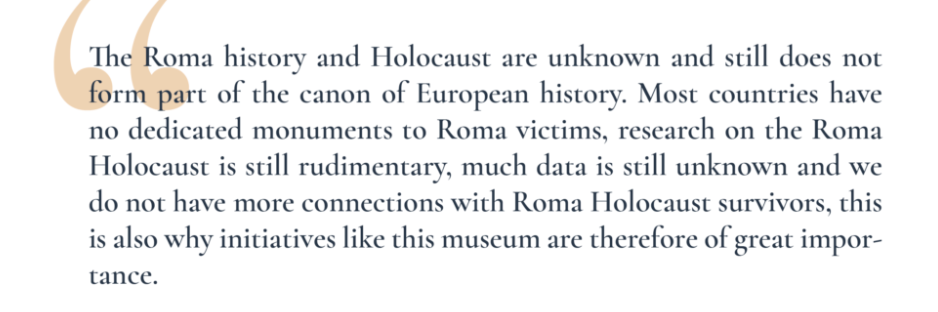
Despite growing scholarship, increasing international recognition, and the development of educational resources, many students complete their education having never learned that hundreds of thousands of Roma were persecuted and murdered under Nazi racial policies. More than eighty years after the Holocaust, the Roma Genocide remains one of the least known aspects of Nazi persecution.
The victims and survivors of the Roma Genocide represented the rich diversity of Romani peoples across Europe, including Sinti, Romungro, Kalderash, Lovari, Olah, Polska Roma, Bergitka Roma, Romanichal, Finnish Kale, Welsh Kale, and many other communities. While “Roma” is commonly used today as an umbrella term, the Nazi genocide targeted diverse Romani peoples and communities throughout Europe.
A personal journey from silence to advocacy
On a personal level, I never learned anything about Roma during the Holocaust throughout my entire Canadian education. It was my grandmother who first shared with me that she and her family from Bük, Hungary, were survivors. My grandmother Klara’s eldest sister, Marika, survived Nazi medical experimentation on her reproductive system, specifically on her womb.
Learning this as a teenager was devastating. It was painful to understand that Roma were hated so profoundly that people sought to humiliate, harm, and murder as many of us as possible. Equally painful was realizing that, although I had been taught extensively about the Holocaust, my family’s experience and the history of my community were completely absent from what I was learning.
As a secondary school Social Studies teacher and co-founder and director of the Canadian Romani Alliance, I have advocated for the inclusion of the Roma Genocide in British Columbia’s Social Studies 10 and Genocide Studies 12 curricula. Because Roma history remains largely unknown in Canada, many educators may not have the knowledge or resources necessary to teach about Roma experiences during the Nazi era, especially since textbooks continue to omit our history from Holocaust education.
Why the absence continues: Romani voices and perspectives
The Roma Genocide is often described as the “forgotten genocide.” However, for Roma, it was not forgotten by accident. It was shaped by centuries of anti-Roma racism, the exclusion of Roma voices from historical narratives, and educational systems that have often failed to recognize Roma experiences as essential to understanding the Holocaust.
Romani scholars, survivors, and educators have long fought to reclaim space within the history of Nazi persecution and the Holocaust:
The Survivor - Ceija Stojka: Austrian Romani survivor Ceija Stojka spent her later life ensuring that the memories of Roma families murdered during the Holocaust would not disappear into silence. Her testimony reminds us that forgetting is not merely the absence of memory - it is the loss of human voices.
The Memory Keeper - Ágnes Daróczi: Hungarian Romani activist and journalist Ágnes Daróczi emphasizes that Roma suffering was not recognized after the Holocaust and that remembrance is an act of justice. Teaching the Roma Genocide restores dignity to victims and ensures Roma history is understood as part of world history.
The Historian - Ian Hancock: Professor Hancock argues that the omission of the Roma Genocide reflects the continuation of anti-Roma racism after 1945. This omission delayed recognition, research, memorialization, and curriculum development.
The Critical Scholar - Ethel Brooks: Professor Brooks asks whose histories are considered worthy of remembrance. She highlights how the absence of Romani voices in education reflects broader patterns of invisibility and exclusion.
The Educator - Ronald Lee: Canadian Romani community leader, writer, and educator Ronald Lee reminds us that students cannot understand Roma persecution if they have never learned Roma history, culture, and contributions beyond stereotypes.
Toward historical justice in education
Together, these perspectives reveal that the absence of the Roma Genocide from classrooms is not simply an educational gap. It reflects historical exclusion, continuing anti-Roma racism, and the marginalization of Romani voices.
As educators, researchers, and members of the IHRA, we share a responsibility to ensure that the Roma Genocide is no longer treated as a footnote, but as an essential chapter of the history of the Holocaust and Nazi persecution. Only then can education fully reflect the experiences of all those targeted by Nazi racial ideology.
Learn more about the work of DIKH HE NA BISTER (“Look and don’t forget” in Romani) – the Roma Genocide Remembrance Initiative that each year mobilizes thousands of young Roma and non-Roma all over Europe on the occasion of 2 August to advance remembrance, recognition, and education about the genocide of Sinti and Roma.